


gear that adapts to every dogs adventure.
why dog gear?
For years, dogs have accompanied us through various environments. People and their dogs have created an unbreakable bond that emphasizes the importance of companionship and their safety.
Over 97% of pet owners consider their pet a family member.


what inspired me?
In spring 2025, I had to chance to sit down with Mike Porter, a retired search and rescue chief from Boulder City, Nevada. We discussed his heroic rescues alongside his partner, a Labrador Retriever cadaver dog named Dexter.
During our conversation, we looked at pictures of the demanding environments and equipment required for Mike and his dog, Dexter. One thing that sparked my interest was how much Mike expressed the frustrations and limitations he has while using a technical dog rappelling harness...
I was so inspired by Mike and Dexter's story that I began researching design opportunities in technical dog harnesses soon after our conversation
survey results
what dog gear is used the most?
I surveyed a mix of first responders and canyoneers who adventure along side their dogs. From my survey results, standard and technical harnesses are the most commonly used gear by adventure dogs.

modularity opportunity?
The issue is these two categories are often completely separate. While they each serve a purpose, they don’t adapt well across different activities. That’s where I saw an opportunity.
keeping the user in mind
why is dog's anatomy an important detail in my design process?
Based on findings from Dogs in Motion by Martin S. Fischer and Karin E. Lilje, the main pivot point of a dog’s front limb is the scapula, not the shoulder joint. The scapula drives over 60% of stride length and rotates forward with each step, showing that movement depends on a system in motion. Harness pressure must avoid major motion zones to prevent strain, as vertical load amplifies stress on the scapula and shoulder joints. Shoulder freedom is essential for full, natural movement.

.png)
the problem
Current dog rappelling harnesses lack adaptable systems that respond to changing terrain, tasks, and movement, creating a need for innovative modular harness designs that allow dogs to participate safely and comfortably in technical adventures alongside their owners.
the opportunity
How might we design an adaptable, modular technical dog rappelling harness that improves comfort, mobility, and safety?
aesthetics & cmf exploration
Aesthetics and forms drawn from desert landscapes and natural layering, using warm earth tones, subtle contrast, and tactile to create a look that feels grounded and cohesive.


ideation process
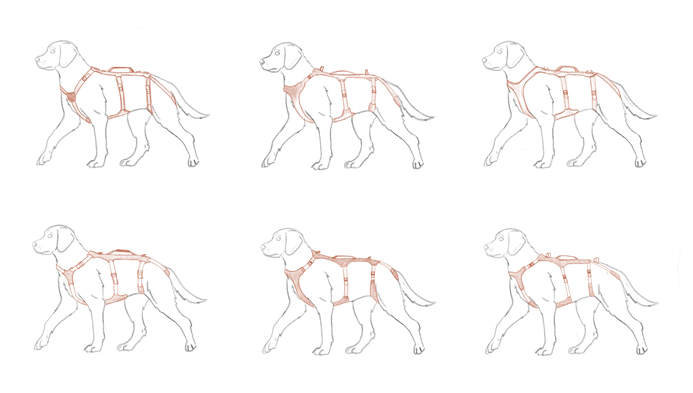
I began with shape, then developed it into refined forms while exploring multiple design directions.


the shadow harness

a
A system made to adapt to every dog's adventure.
configurations

Everyday Standard Harness
Hiking Harness
Canyoneering Harness
Canyoneering Harness w/ Saddle Bags
patterning in rhino3D
After I decided the features and design details, I went into Rhino3D using a model of an Australian Cattle Dog to figure out the fit and size of the harness pieces.
.png)
.png)
prototyping


